Documentation Index
Fetch the complete documentation index at: https://lightdash-mintlify-43685d28.mintlify.app/llms.txt
Use this file to discover all available pages before exploring further.
Core capabilities
AI agents in Lightdash allow you to:- Ask questions in natural language - Simply type what you want to know about your data, like “What’s our total revenue by region?” or “Show me user growth over the last 6 months”
- Get instant visualizations - Receive bar charts, time series, and tables automatically generated based on your questions
- Explore interactively - Follow up with additional questions, drill down into specific data points, or request different chart types
- Maintain conversation context - AI agents remember your conversation history, so you can build on previous questions and refine your analysis
- Provide text-only responses - Get answers in natural language when visualizations aren’t needed
- Guide you to the right data - Direct you to the most relevant explores or tables for your questions
- Discover existing content - Find and share relevant charts and dashboards that have already been created in your project
- Generate complete dashboards - Create multiple related visualizations at once that tell a cohesive story about your data, perfect for executive summaries or thematic analyses
- Compare across time periods - Ask for month-over-month, year-over-year, or any custom period offset, and the agent adds a comparison column next to each metric automatically
Asking about a chart or dashboard
You can launch an AI conversation with a chart or dashboard pre-loaded as context. From the resource’s⋯ menu, click Ask AI Agent.
This opens a new tab on the new-thread page for your default agent. The chart or dashboard appears as a pinned context card above the input, and the agent treats it as the subject of the conversation.
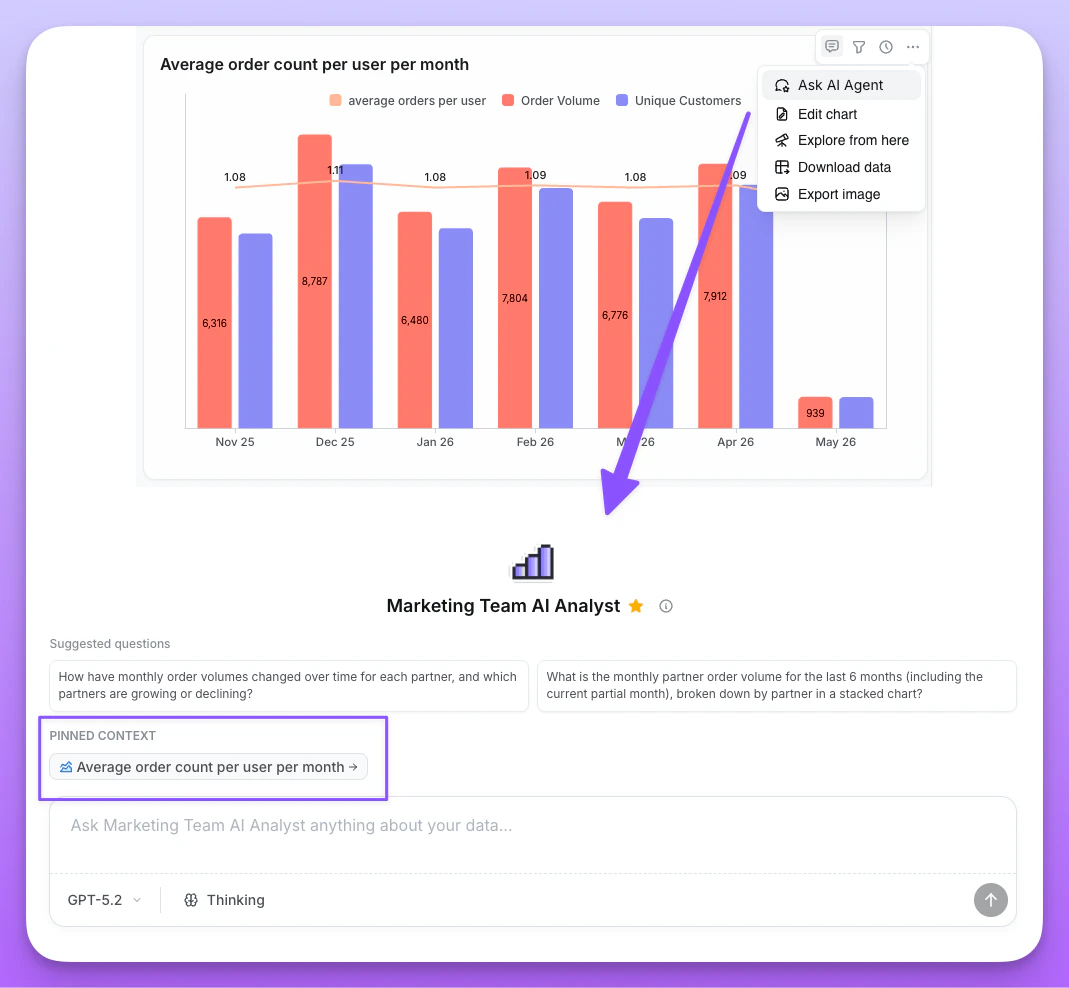
Pinned context
- The pinned card stays visible above your message in the thread, so anyone reading later can tell what was being discussed.
- Click the pinned card to open the chart or dashboard in a new tab.
- The pinned context persists across follow-up messages — “now break it down by region” still refers to the originally pinned chart.
What you can ask
When you pin a saved chart, the agent can read its actual data (subject to your data access setting). It honors the chart’s saved filters, sorts, and custom metrics, so you can ask:- “Why is this trending up?”
- “Are there outliers in this chart?”
- “Compare this chart’s last 30 days to the previous period.”
Example use cases
Period-over-period comparisons
Agents can answer time-comparison questions directly — month-over-month, year-over-year, or any custom offset — without you having to set up the comparison in the Explorer first. When you ask a comparison question, the agent picks a base metric, a time dimension, a granularity (day, week, month, quarter, or year), and an offset (how many periods back). It then runs the query and adds a comparison column next to the base metric, labelled with the offset (for example,Revenue (Previous month)).
Prompts that work well
- “Compare revenue to last month”
- “Month-over-month new users”
- “Year-over-year orders by week”
- “Show revenue this quarter vs the previous quarter, and vs the same quarter last year”
- The granularity must match the time dimension’s interval — ask for “monthly revenue vs last month” (not “daily revenue vs last month”).
- The agent can’t yet sort or filter on the generated comparison column directly; sort or filter on the base metric or the time dimension instead.
Advanced visualizations with window functions
AI agents can handle complex analytical queries that would traditionally require writing intricate SQL or YAML configurations. In this example, we demonstrate building a 3-month rolling average visualization using nothing but natural language.
This demo shows:
- Creating complex window function calculations with plain English
- Building a 3-month rolling average without writing SQL or YAML
- AI agent understanding your semantic layer context automatically
- Generating production-ready charts from a single natural language query
- No need to manually configure partitions, ordering, or frame clauses
- From question to visualization in seconds, not hours
FAQs
- Does Lightdash store the query data?
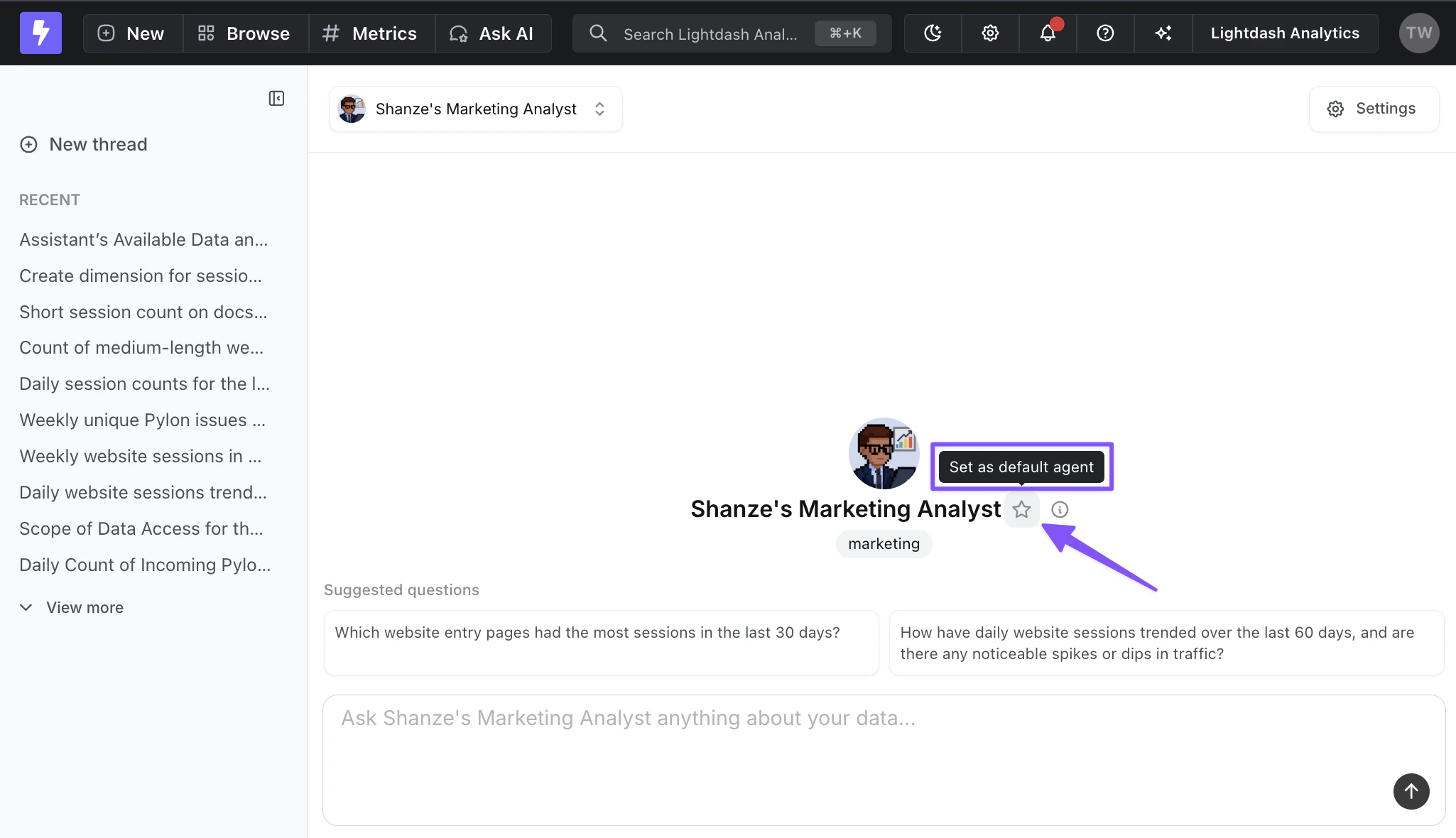
- Can I assign a default agent?